Fentanyl in Workplace Drug Testing: What Employers Need to Know in 2026
Does Workplace Drug Testing Detect Fentanyl?
Some workplace drug testing programs can detect fentanyl, but not every drug test includes fentanyl screening. Federal workplace drug testing programs have expanded fentanyl testing, while DOT-regulated testing has proposed, but not yet finalized, similar changes. Employers should review their testing panels, policies, and safety-sensitive job duties to determine whether fentanyl screening should be addressed in their workplace drug testing program.
Why Fentanyl Belongs in the Workplace Safety Conversation
Some workplace drug testing programs can detect fentanyl, but not every drug test includes fentanyl screening. Federal workplace drug testing programs have expanded fentanyl testing, while DOT-regulated testing has proposed, but not yet finalized, similar changes. Employers should review their testing panels, policies, and safety-sensitive job duties to determine whether fentanyl screening should be addressed in their workplace drug testing program.
Why Fentanyl Belongs in the Workplace Safety Conversation
Every employer has heard about fentanyl. Most have seen headlines about overdoses, counterfeit pills, and the growing impact of synthetic opioids across the country. What many employers may not have considered is how fentanyl could affect workplace safety, employee performance, and liability exposure inside their own organization.
For employers in transportation, construction, manufacturing, energy, warehousing, oil and gas, healthcare, and other safety-sensitive industries, fentanyl is not just a public health issue. It is a workplace safety issue. An employee who is impaired, drowsy, confused, or unable to react quickly may place themselves, coworkers, customers, and the public at risk. CDC/NIOSH guidance identifies fentanyl as a powerful synthetic opioid and discusses workplace exposure concerns for certain occupations.
The challenge is that many employers assume their current testing program already covers fentanyl. That may not be true. Some drug testing panels include fentanyl screening, while others do not. DOT-regulated employers also need to understand that fentanyl has been proposed for addition to the DOT drug testing panel, but as of the publication date of this article, that proposed rule has not been finalized.
That distinction matters. A company can invest in random testing, post-accident drug testing, supervisor training, and drug-free workplace policies while still maintaining a testing panel that does not screen for one of the most dangerous synthetic opioids involved in today’s overdose crisis.
For employers, the goal is not to diagnose addiction or make assumptions about employees. The goal is to build a safer workplace by understanding the risks, training supervisors properly, reviewing policies, and making informed decisions about workplace fentanyl testing, reasonable suspicion testing, and overall drug and alcohol program compliance. DATCS training emphasizes that supervisors should observe and document objective facts rather than attempt to determine the cause of possible impairment.
Does DOT Test for Fentanyl?
No. As of the publication date of this article, fentanyl is not included in the standard DOT drug testing panel. However, the U.S. Department of Transportation has issued a Notice of Proposed Rulemaking that would add fentanyl and norfentanyl to DOT drug testing panels if finalized. Employers should continue following current DOT requirements while monitoring future regulatory updates.
What Is Fentanyl?
Fentanyl is a synthetic opioid. Pharmaceutical fentanyl has legitimate medical uses and may be prescribed by healthcare professionals to treat severe pain, especially after surgery or for advanced cancer pain. It is typically administered in controlled medical forms such as patches or lozenges.
The larger public safety concern involves illegally manufactured fentanyl. Illicit fentanyl is commonly distributed through illegal drug markets and may appear as a powder, be mixed with other substances, or be pressed into counterfeit pills made to resemble legitimate prescription medications.
Fentanyl is especially dangerous because of its potency. The CDC states that fentanyl is up to 50 times stronger than heroin and 100 times stronger than morphine. NIDA also describes fentanyl as 50 to 100 times more potent than morphine. Even a small amount can be dangerous, especially when a person does not know fentanyl is present.
This is one reason overdoses happen so frequently. Many people do not intentionally seek out fentanyl. They may believe they are taking something else entirely. According to the CDC, illicit fentanyl is often added to other drugs because of its potency, and it may be mixed into heroin, cocaine, methamphetamine, or counterfeit pills.
For employers, that creates a difficult reality. An employee may be affected by fentanyl without fully understanding what they consumed. From a workplace safety perspective, the employer’s concern is not intent. The concern is whether an employee can safely perform their duties. DATCS training emphasizes that workplace impairment concerns should be addressed through observation, documentation, and policy-based procedures.
The Hidden Workplace Risk of Counterfeit Pills
One of the most important fentanyl risks for employers to understand is counterfeit pills. The CDC notes that illegally made fentanyl is increasingly pressed into counterfeit pills that may resemble prescription opioids or medications such as alprazolam. Pharmaceutical fentanyl does not come in pill form, but counterfeit pills may be designed to look like prescription drugs.
This matters in the workplace because employees may not think they are using fentanyl. A person may believe they obtained a pain pill, anxiety medication, or another substance from an informal source when the substance actually contains fentanyl. The CDC states that drugs mixed with fentanyl are extremely dangerous and that many people may be unaware their drugs contain it.
That creates several workplace concerns:
- An employee may unexpectedly experience impairment.
- A supervisor may observe symptoms without knowing the cause.
- A standard drug testing panel may not include fentanyl screening.
- A safety-sensitive employee may create risk before the employer realizes there is a problem.
This is why employers should avoid assuming fentanyl risk only applies to people with known opioid use. In today’s drug environment, fentanyl exposure can occur through counterfeit pills and substances that employees may not realize contain synthetic opioids.
Employers with safety-sensitive employees should consider whether their current workplace testing program, reasonable suspicion testing procedures, and supervisor training adequately address the possibility of fentanyl-related impairment in the workplace. DATCS states that it supports employers with program management, policy development, ongoing training, and compliance guidance for workplace drug and alcohol testing programs.
Why Employers Are Paying Attention
Fentanyl continues to play a major role in the national overdose crisis. CDC information identifies synthetic opioids, primarily fentanyl, as a major contributor to overdose deaths in the United States.
Employers are paying attention for another reason as well: workplace testing data is beginning to show fentanyl as a more visible concern. Industry reporting citing Quest Diagnostics’ 2025 Annual Drug Testing Index stated that fentanyl positivity in urine workplace drug tests increased from 0.91% in 2023 to 1.13% in 2024. The same reporting stated that fentanyl-positive results were more than seven times higher in random testing compared with pre-employment screening.
That workplace trend is important. If fentanyl is more likely to appear in random testing than pre-employment testing, employers may face risk after an employee is already performing job duties. For safety-sensitive employers, that distinction matters because random testing, post-accident drug testing, and reasonable suspicion testing are designed to help address risk during employment, not only before hiring.
This is especially relevant in industries where one impaired decision can cause serious harm. Transportation companies, construction firms, manufacturing operations, energy employers, and other organizations with safety-sensitive roles should evaluate whether their current program addresses the substances most relevant to today’s workplace risks.
Employers that are unsure whether their current workplace fentanyl testing strategy is adequate may benefit from a policy and panel review. DATCS helps employers with nationwide testing, workplace drug and alcohol testing program support, and compliance guidance tailored to regulated and non-regulated employers.
How Fentanyl Can Affect Workplace Safety
Fentanyl can depress the central nervous system and breathing function. CDC/NIOSH workplace guidance identifies fentanyl as a powerful synthetic opioid and notes that exposure can be fatal.
From a workplace safety standpoint, possible signs associated with fentanyl or opioid-related impairment may include:
- Drowsiness
- Confusion
- Dizziness
- Unusual tiredness
- Trouble breathing
- Sweating
- Mood swings
- Impaired judgment
- Slowed reaction times
DATCS training identifies several similar indicators, including drowsiness, confusion or dizziness, trouble breathing, sweating, unusual tiredness, dilated pupils, and mood swings.
Those effects can be dangerous in any workplace, but they are especially concerning when employees operate vehicles, handle hazardous materials, use heavy equipment, work around machinery, supervise crews, enter confined spaces, or perform tasks requiring constant attention.
A slowed reaction time on a construction site, a missed safety step in a manufacturing facility, or impaired judgment behind the wheel of a commercial vehicle can place more than one person at risk. That is why employers should treat fentanyl awareness as part of a broader safety and compliance conversation, not simply a drug testing topic.
Is Fentanyl Included in Drug Tests?
The answer depends on the type of drug testing program and the specific panel being used.
DOT Testing
DOT-regulated employers must follow federal drug and alcohol testing requirements under 49 CFR Part 40. The DOT Part 40 framework describes drug and alcohol testing procedures for federally regulated transportation workplace programs.
As of the publication date of this article, fentanyl is not included in the standard DOT drug testing panel. However, DOT has issued a Notice of Proposed Rulemaking that would add fentanyl and norfentanyl to its testing panels.
The proposed change is important because it signals where federal transportation testing may be headed. If finalized, it would represent a significant update for DOT-regulated employers. For now, employers should continue to follow existing DOT rules while monitoring official DOT updates.
Compliance Note: As of publication, DOT has proposed adding fentanyl and norfentanyl to DOT drug testing panels, but the rule has not been finalized. Employers should follow current DOT requirements and monitor official DOT updates before making compliance assumptions.
Federal Workplace Testing
Federal workplace drug testing programs have already moved further in this direction. Source materials reviewed during research indicate that SAMHSA updated federal workplace testing panels to include fentanyl and norfentanyl, with implementation beginning in July 2025 for covered federal workplace testing programs. \
Employers should be careful not to confuse federal workplace testing updates with DOT testing requirements. A change to federal workplace testing does not automatically mean the same requirement has already taken effect for DOT-regulated employers. \
Non-DOT Testing
Non-DOT employers generally have more flexibility when designing workplace drug testing programs, subject to applicable federal, state, and local laws. Many non-DOT employers use expanded panels, customized testing options, or safety-sensitive testing policies that go beyond a basic panel.
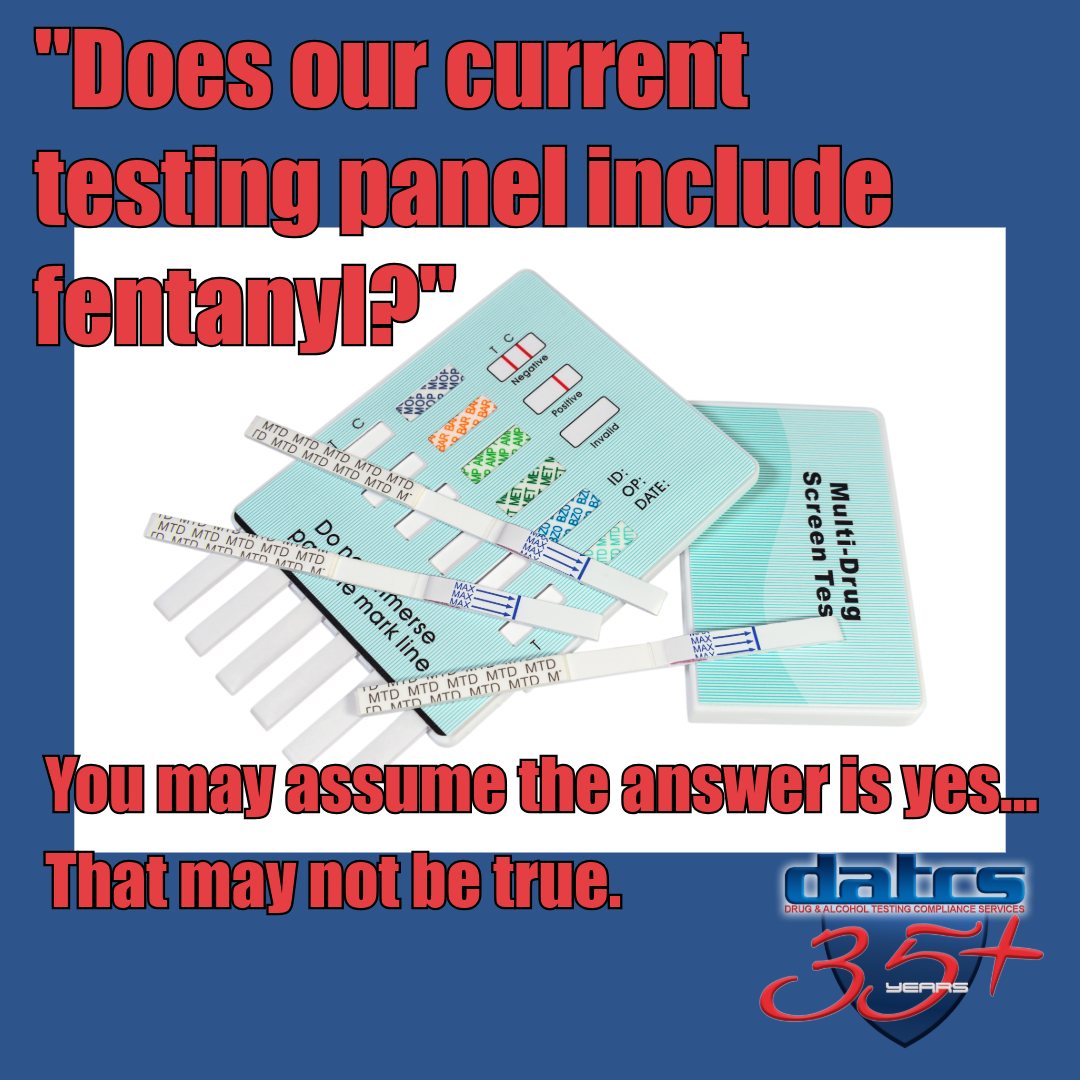
The key point is simple: employers should not assume fentanyl is included. The only way to know is to review the specific testing panel being used and confirm whether fentanyl and norfentanyl are listed.
Many employers are surprised to discover that their current workplace drug testing program may not include fentanyl screening. Reviewing your testing panel, company policy, and safety-sensitive job classifications can help identify potential gaps before an incident occurs. DATCS assists employers with testing program support, expanded drug testing panel options, and ongoing compliance guidance.
Is Fentanyl Included in a Standard 5-Panel Drug Test?
No. Fentanyl is not typically included in a standard 5-panel drug test. Employers who want fentanyl screening generally need an expanded drug testing panel or a testing program that specifically includes fentanyl and norfentanyl.
This is one of the most important distinctions for employers reviewing their workplace fentanyl testing strategy. A standard drug test may detect certain substances while missing others that require specialized testing. Employers should review their panel with a qualified testing provider instead of assuming that a generic “opioid” category automatically includes fentanyl.
State Laws May Impact Workplace Drug Testing Programs
While federally regulated employers must follow applicable federal requirements, non-DOT employers should also consider state and local laws when evaluating fentanyl screening, expanded drug testing panels, or reasonable suspicion testing procedures. Testing requirements and employer obligations may vary depending on the jurisdiction, industry, and type of workforce involved.
Before implementing changes to a fentanyl testing panel, adding fentanyl screening, or modifying reasonable suspicion testing procedures, employers should review applicable laws and consult qualified compliance professionals. Policy reviews are an important part of maintaining a workplace drug testing program that reflects current risks, business needs, and regulatory obligations.
For employers operating in multiple states or safety-sensitive environments, a regular drug and alcohol policy review can help identify outdated language, testing panel gaps, and training needs before a workplace incident occurs. DATCS provides employer support for workplace drug and alcohol testing programs, policy development, training, and compliance guidance.
Signs of Possible Fentanyl Misuse in the Workplace
Supervisors should not try to diagnose drug use. Their role is to observe, document, and follow company policy. DATCS reasonable suspicion training emphasizes that supervisors are not responsible for determining whether an employee is using drugs or alcohol. Instead, supervisors should observe and document specific, objective behaviors and follow company policy, DOT requirements, or HR procedures when appropriate.
Possible indicators that may require attention include:
- Drowsiness
- Confusion
- Dizziness
- Trouble breathing
- Sweating
- Unusual tiredness
- Dilated pupils
- Mood swings
- Erratic or unusual behavior
- Poor coordination
- Slurred speech
- Significant decline in job performance
- Safety concerns or near-misses
DATCS training identifies several fentanyl indicators and also emphasizes that reasonable suspicion should be based on observable facts such as appearance, behavior, speech, body odor, and performance.
These signs do not prove fentanyl use. They may also be caused by fatigue, medical conditions, prescribed medication, stress, illness, or other factors. That is why reasonable suspicion training matters. Supervisors should be trained to document what they see, hear, smell, or observe, not to speculate about the cause.
Example: Reasonable Suspicion in Practice
Consider this workplace scenario.
A forklift operator who normally arrives alert and prepared appears unusually tired during a pre-shift meeting. The employee has difficulty focusing, seems confused when given routine instructions, and later nearly strikes a storage rack during a normal maneuver. The supervisor also notices slow movements and unusual speech patterns.
In this situation, the supervisor should not accuse the employee of fentanyl use or attempt to determine what substance may be involved. The supervisor’s role is to document the specific observations, follow company policy, involve the appropriate manager or designated employer representative, and take action consistent with reasonable suspicion procedures. DATCS reasonable suspicion training emphasizes that reasonable suspicion should be based on specific, contemporaneous, and articulable observations involving appearance, behavior, speech, or body odors.
That approach protects the employee, the supervisor, the employer, and the workplace. It keeps the focus on safety and policy rather than assumptions.
What Supervisors Should Do
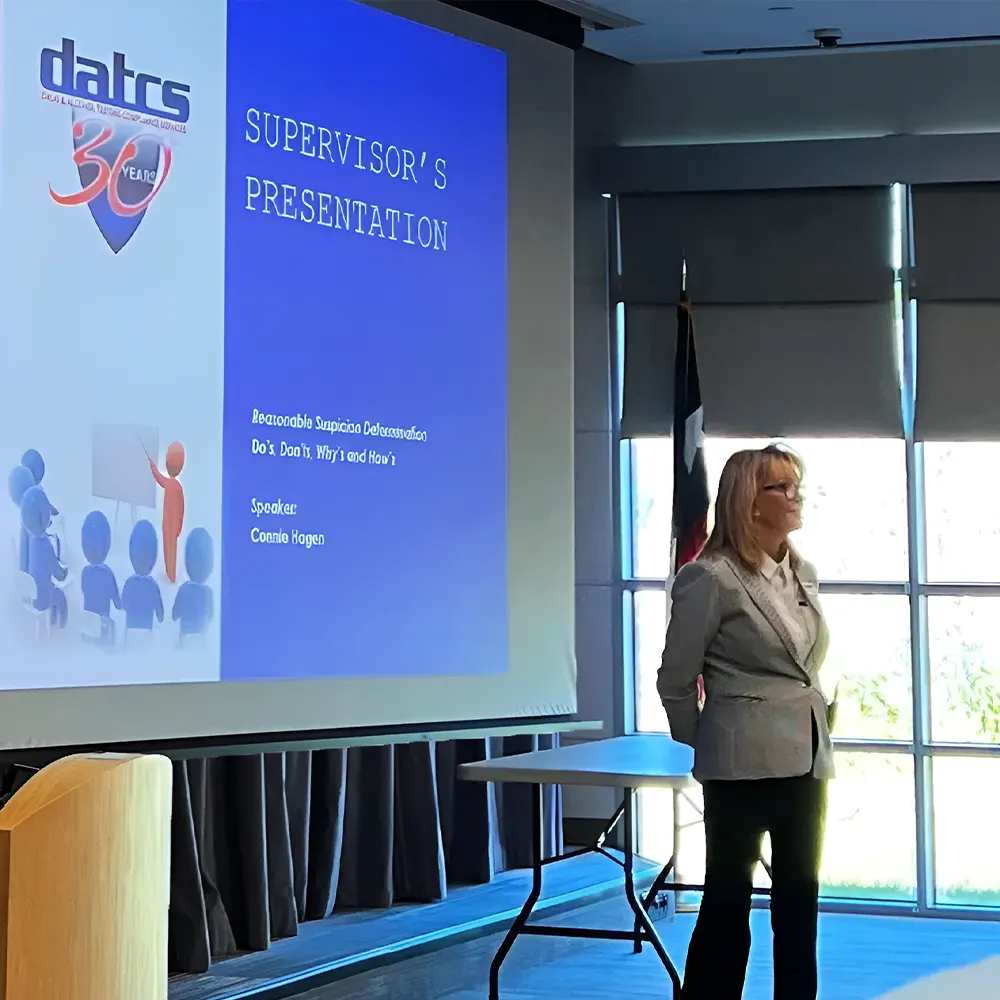
A strong reasonable suspicion process usually comes down to three core responsibilities: observe, document, and follow policy.
- Observe
Supervisors should look for objective indicators such as changes in appearance, behavior, speech, coordination, body odor, or performance. DATCS training emphasizes that reasonable suspicion is based on what a supervisor can see, hear, smell, or observe, not assumptions or opinions.
- Document
Documentation should be timely, factual, and specific. DATCS training explains that supervisors should record exactly what they observed, document the situation promptly, and be able to explain the observations clearly.
- Follow Reasonable Suspicion Procedures
Employers should have clear procedures in place before a reasonable suspicion situation occurs. DATCS training identifies practical planning questions, including where testing will occur, who will arrange transportation, how the employee will be transported after testing, what procedures apply if results are positive, and who should be contacted after normal business hours.
Effective reasonable suspicion testing begins long before a workplace incident occurs. DATCS provides supervisor training designed to help employers strengthen internal readiness, maintain documentation integrity, and support audit-ready workplace drug and alcohol testing programs.
Why Quick Response Matters for Post-Accident and Reasonable Suspicion Testing
Workplace drug and alcohol testing situations often require fast, organized action. In post-accident and reasonable suspicion situations, employers may need to coordinate testing, transportation, documentation, supervisory communication, and removal-from-duty procedures while maintaining fairness and consistency.
DATCS training emphasizes that employers should establish procedures before a reasonable suspicion test is needed, including where the collection will occur, who will arrange transportation, how the employee will be transported afterward, and who should be contacted after normal business hours.
For time-sensitive events, access to reliable testing resources can be critical. DATCS provides nationwide mobile drug and alcohol testing services and states that mobile teams are available to support employers with urgent and routine workplace testing needs, including post-accident, random, and reasonable suspicion situations.
Fentanyl Terminology Employers Should Know
Fentanyl
Fentanyl is a synthetic opioid that may be prescribed for severe pain but is also illegally manufactured and distributed through illegal drug markets. CDC information states that fentanyl is up to 50 times stronger than heroin and 100 times stronger than morphine.
Illegally Manufactured Fentanyl
Illegally manufactured fentanyl refers to fentanyl produced and sold outside regulated pharmaceutical channels. CDC information states that it may be found in powder form, mixed with other drugs, or pressed into counterfeit pills.
Norfentanyl
Norfentanyl is a metabolite of fentanyl. DOT’s proposed rulemaking specifically discusses adding fentanyl and norfentanyl to DOT drug testing panels.
Fentanyl Screening
Fentanyl screening refers to testing that specifically checks for fentanyl or related markers such as norfentanyl. Employers should confirm whether fentanyl screening is part of their current testing program because not every drug testing panel includes it.
Drug Testing Panel
A drug testing panel is the group of substances a drug test is designed to detect. Not every panel includes fentanyl, which is why employers should verify the substances included in their current workplace drug testing program.
Expanded Drug Testing Panel
An expanded drug testing panel may include additional substances beyond a basic panel. Employers considering fentanyl screening may need to review expanded drug testing panel options with their testing provider.
Reasonable Suspicion
Reasonable suspicion is based on specific, objective observations that may indicate a possible policy violation or safety concern. DATCS training emphasizes that reasonable suspicion should be based on observable indicators rather than assumptions.
Safety-Sensitive Position
A safety-sensitive position is a job where impairment can create risk for the employee, coworkers, customers, or the public. DOT-regulated industries commonly include safety-sensitive roles subject to specific drug and alcohol testing requirements.
Not Sure If Your Testing Panel Includes Fentanyl?
Many employers assume fentanyl is already included in their workplace drug testing program when it may not be.
A policy created years ago may not reflect today’s workplace drug trends, expanded testing options, or emerging compliance considerations. As fentanyl screening becomes a more common workplace safety topic, employers should evaluate whether their current program reflects the risks their workforce actually faces.
Questions employers should ask include:
- Does our current testing panel include fentanyl screening?
- Are we using a standard or expanded drug testing panel?
- Do our supervisors understand reasonable suspicion procedures?
- Have we reviewed our drug and alcohol policy within the last year?
- Are we prepared for future DOT testing changes?
- Do we have access to post-accident and reasonable suspicion testing resources?
- Are safety-sensitive employees covered by appropriate testing procedures?
DATCS helps employers evaluate testing programs, review policy language, strengthen supervisor training, and identify opportunities to improve workplace safety through comprehensive drug and alcohol testing programs. DATCS states that it supports employers with nationwide testing, policy development, program management, training, and compliance guidance.
Frequently Asked Questions About Fentanyl Workplace Drug Testing
Does fentanyl show up on a drug test?
Yes, fentanyl can show up on a drug test if the testing panel includes fentanyl screening. However, not all workplace drug tests automatically include fentanyl. Employers should review their testing panel to determine whether fentanyl and norfentanyl are included.
How long does fentanyl stay in the body?
Detection windows vary based on factors such as dosage, frequency of use, metabolism, body composition, and the type of test administered. Employers should consult their testing provider, laboratory, or Medical Review Officer for test-specific detection information.
Does DOT test for fentanyl?
As of the publication date of this article, fentanyl is not included in the standard DOT drug testing panel. However, DOT has issued a Notice of Proposed Rulemaking that would add fentanyl and norfentanyl to future DOT testing requirements.
Will DOT eventually require fentanyl testing?
DOT has formally proposed adding fentanyl and norfentanyl through the federal rulemaking process. While many safety professionals are monitoring the proposal closely, employers should remember that the rule has not been finalized as of publication.
Can employers test specifically for fentanyl?
Yes. Many laboratories offer fentanyl-specific screening or expanded drug testing panels that include fentanyl and norfentanyl. Employers should review available testing options and determine whether expanded testing aligns with their workplace safety objectives.
Why isn’t fentanyl included in every drug test?
Many traditional workplace drug testing panels were developed before fentanyl became a major factor in the national overdose crisis. Because fentanyl is a synthetic opioid, it often requires specific testing methods and is not automatically included in every standard testing panel.
Should non-DOT employers add fentanyl to their testing panel?
That depends on the employer’s industry, workforce, safety-sensitive positions, workplace risks, company policy, and applicable state laws. Employers operating commercial vehicles, heavy equipment, industrial machinery, or safety-sensitive operations may wish to evaluate whether expanded testing panels support their safety goals.
Your Title Goes Here
That depends on the employer’s industry, workforce, safety-sensitive positions, workplace risks, company policy, and applicable state laws. Employers operating commercial vehicles, heavy equipment, industrial machinery, or safety-sensitive operations may wish to evaluate whether expanded testing panels support their safety goals.
What industries are most concerned about fentanyl-related workplace risks?
While any employer may be affected, fentanyl concerns are often highest in transportation, construction, manufacturing, energy, warehousing, pipeline operations, and other industries where impairment can create serious safety risks.
Can prescribed fentanyl cause a positive drug test?
Yes. Prescription fentanyl can be detected by tests that specifically screen for fentanyl. Medical Review Officer procedures help determine whether a positive result is linked to a legitimate prescription when applicable.
Can an employee legally use prescribed fentanyl and still work?
Possibly. Whether an employee can safely perform their job while using prescribed fentanyl depends on the nature of the position, workplace policies, medical considerations, and applicable regulations. Employers should follow established policies and Medical Review Officer procedures rather than making assumptions.
Does fentanyl show up during random drug testing?
If fentanyl is included in the testing panel, it can be detected during random testing. Industry reporting citing workplace testing data has noted higher fentanyl positivity rates in random testing than in pre-employment testing.
What are common signs of possible fentanyl misuse in the workplace?
Possible indicators may include drowsiness, unusual tiredness, confusion, dizziness, trouble breathing, mood swings, poor coordination, unusual behavior, and a decline in job performance. Supervisors should focus on objective observations and follow company policy when concerns arise.
What should supervisors do if they suspect fentanyl misuse?
Supervisors should not diagnose drug use or accuse employees of using fentanyl. DATCS reasonable suspicion training emphasizes observing, documenting, and reporting objective facts while following established company procedures.
What should be included in a fentanyl workplace safety policy?
A comprehensive workplace substance misuse policy may address testing procedures, supervisor responsibilities, employee reporting requirements, reasonable suspicion procedures, post-accident testing, return-to-duty expectations, and available support resources. DATCS training emphasizes clear procedures and documentation for reasonable suspicion situations.
Can accidental fentanyl exposure occur in the workplace?
CDC/NIOSH guidance identifies emergency responders, healthcare workers, and certain clinical personnel among occupations that may encounter fentanyl exposure risks during the course of their work. Employers in these environments should ensure proper safety protocols and training are in place.
Why should employers care about counterfeit pills?
Many counterfeit pills are designed to look like legitimate prescription medications. Employees may unknowingly consume substances containing fentanyl while believing they are taking something else. This creates a workplace safety concern regardless of intent.
What should employers do after a positive fentanyl test?
Employers should follow their written drug and alcohol policy, applicable DOT or non-DOT requirements, and Medical Review Officer procedures. Appropriate actions depend on the specific testing program, regulatory requirements, and workplace policies.
Could fentanyl become the next major workplace drug testing trend?
Fentanyl is already influencing workplace drug testing discussions across the country. Federal workplace testing updates, proposed DOT rule changes, workplace testing trends, and ongoing overdose concerns have prompted many employers to re-evaluate their testing programs and workplace safety strategies.
Conclusion: How DATCS Can Help
Fentanyl does not require employers to panic. It does require employers to be proactive.
A strong workplace drug testing program starts with asking the right questions:
- Does our current testing panel include fentanyl screening?
- Are we using the right drug testing panel for our workforce?
- Are our supervisors prepared to recognize possible impairment?
- Do our policies address reasonable suspicion situations?
- Are we following current DOT requirements?
- Are we monitoring future DOT testing changes?
- Do we have access to post-accident and reasonable suspicion testing resources?
DATCS helps employers build safer, more compliant workplaces through testing, policy development, supervisor education, reasonable suspicion training, and nationwide testing support. DATCS states that it has provided drug and alcohol testing services for more than 35 years and supports employers with full-service program management, policy development, ongoing training, and compliance guidance.
For employers that need rapid response testing, DATCS also provides nationwide mobile drug and alcohol testing services, including support for post-accident, random, and reasonable suspicion situations.
As fentanyl continues to reshape discussions surrounding workplace safety and drug testing, employers who review their policies, understand their testing panels, and invest in supervisor training will be better positioned to respond to emerging risks while maintaining a safe and productive workplace.