Post-Mortem DNA Profiles: Preserve DNA Before Burial or Cremation
When a loved one passes away, families are often faced with difficult decisions in a short period of time. Funeral arrangements must be made, legal affairs settled, and final wishes honored—all while navigating grief and loss.
One decision that is rarely discussed, but can have lasting value for future generations, is whether to preserve the deceased individual’s DNA.
In our previous article,“Getting Answers: A Comprehensive Guide to Postmortem DNA Testing,” we explored the many reasons families seek DNA testing after the death of a loved one. Those situations often involve inheritance disputes, paternity questions, Social Security survivor benefits, family relationship verification, genealogy research, or simply obtaining personal closure.
What many families don’t realize is that there may be an opportunity to preserve those answers before the questions ever arise.
A post-mortem DNA profile allows families to preserve genetic information before burial or cremation, helping ensure that future DNA testing remains possible if the need ever develops. While no one can predict what questions the future may bring, preserving a DNA profile can provide peace of mind and help prevent significant legal, logistical, and emotional challenges later.
What Is a Post-Mortem DNA Profile?
A post-mortem DNA profile is a genetic profile created from biological samples collected after an individual’s death.
Unlike DNA testing performed to answer a specific question, a DNA profile is often created and stored proactively. It serves as a preserved genetic record that can be used for future testing if needed.
Approved specimen types may include:
- Blood
- Hair follicles with roots attached
- Fingernails
- Toenails
- Teeth
- Bone samples
The collected specimen is analyzed by an accredited laboratory to create a unique genetic profile that may later be used for identification purposes or comparison testing.
Many families choose to preserve DNA simply so the option remains available in the future.
How Is a Post-Mortem DNA Profile Different From Post-Mortem DNA Testing?
This distinction is important.
A post-mortem DNA test is generally performed when there is an immediate question that needs an answer. As discussed in our previous guide, common reasons include establishing paternity, confirming biological relationships, resolving inheritance disputes, obtaining government benefits, or supporting legal proceedings. [datcs.com]
A post-mortem DNA profile, however, is often created before any specific testing need exists.
Think of it as preserving an important family record.
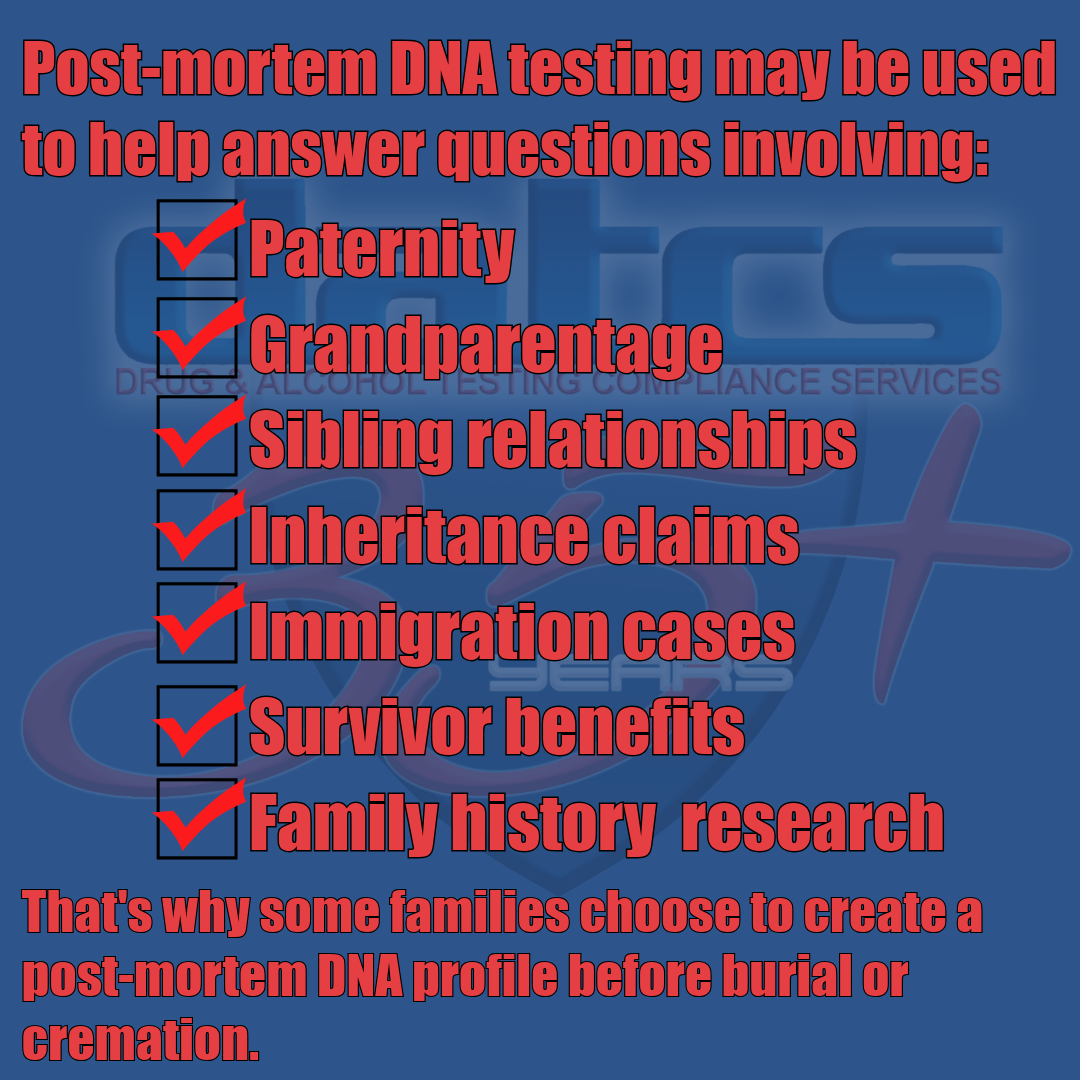
Rather than scrambling to locate and collect DNA years later, families already have the genetic profile available if future questions arise involving:
- Paternity
- Maternity
- Grandparentage
- Inheritance rights
- Government benefits
- Immigration matters
- Family history research
- Identification purposes
The best time to preserve DNA is often before anyone knows it will be needed.
Why Families Preserve DNA
Many people assume that post-mortem DNA testing is rare.
In reality, requests for DNA testing after death occur for a wide variety of legal, personal, and family-related reasons.
Family Relationship Testing
One of the most common reasons families seek post-mortem DNA testing is to establish biological relationships.
Situations may involve:
- Paternity testing
- Maternity testing
- Sibling testing
- Grandparent testing
- Aunt and uncle testing
- Extended family relationship testing
In some cases, a parent passes away before a DNA test can be completed. In others, questions about biological relationships arise years later.
A preserved DNA profile allows those questions to be answered without having to locate and collect a specimen from a deceased individual years after burial.
For more information about family relationship testing, visit DATCS’ DNA Testing Services.
Social Security, Survivor Benefits, and Government Programs
Our previous post discussed situations where post-mortem DNA testing may be needed to establish eligibility for Social Security survivor benefits, veterans benefits, or other government programs.
These matters can arise unexpectedly and sometimes years after a person’s death.
A preserved DNA profile can help ensure that future testing options remain available when documentation is needed.
Estate and Inheritance Matters
Questions involving wills, trusts, and probate proceedings can emerge long after an individual has passed away.
Inheritance disputes may require verification of biological relationships to determine:
- Heirship rights
- Beneficiary eligibility
- Estate distribution
- Family relationship claims
When DNA has already been preserved, the process of obtaining those answers can be significantly easier.
In situations involving legal proceedings, proper chain-of-custody documentation becomes especially important.
Learn more about legally documented collections and court-related testing through DATCS’ Court-Ordered Testing Services.
Immigration Cases
Family-based immigration matters occasionally require proof of biological relationships.
If a parent, petitioner, or relative passes away before testing is completed, proving those relationships may become significantly more difficult.
Preserving DNA before burial or cremation can help maintain future options should biological verification become necessary.
Genealogy and Family History Research
Not every reason for preserving DNA involves a legal matter.
For many families, DNA is part of their history.
Future generations may wish to learn more about:
- Family lineage
- Ancestral connections
- Unknown relatives
- Genetic heritage
- Family medical history
Just as families preserve photographs, military records, family Bibles, journals, and heirlooms, a DNA profile can become another valuable piece of a family’s legacy.
Sometimes the Hardest Part Isn't the Testing—It's Obtaining the Sample
The science behind DNA testing is remarkably reliable.
Often, the greater challenge is obtaining a suitable specimen.
As we explained in our previous guide, post-mortem DNA collections frequently require coordination with funeral homes, attorneys, next of kin, coroners, medical examiners, and laboratories. Depending on the situation, court orders, legal documentation, and formal authorizations may also be required.
The testing itself may be straightforward.
Obtaining the sample often is not.
That reality is one reason more families are beginning to consider preserving DNA before burial or cremation.
Why Timing Matters
The best opportunity to preserve DNA is usually while the deceased individual remains in the care of:
- A funeral home
- A hospital
- A medical examiner
- A coroner’s office
- Another authorized custodian
At this stage:
- Identity can be properly verified.
- Required authorizations can be obtained.
- Chain-of-custody procedures can be documented.
- Suitable biological samples are more easily accessible.
Once burial or cremation occurs, options become considerably more limited.
Why Families Sometimes Wish DNA Had Been Preserved Earlier
At DATCS, we’ve encountered situations where DNA testing became necessary months or years after a loved one was laid to rest.
When DNA was not preserved beforehand, obtaining a specimen may require extensive coordination involving:
- Attorneys
- Courts
- Funeral homes
- Cemeteries
- Medical professionals
- Transportation providers
- Accredited laboratories
In some circumstances, exhumation may even need to be considered.
What could have been a relatively straightforward collection before burial can evolve into a complicated and expensive process later.
For families already dealing with loss, those additional hurdles can be overwhelming.
A post-mortem DNA profile helps preserve options and may eliminate many of those future challenges.
What Samples Can Be Used for Post-Mortem DNA Collection?
Many people associate DNA testing with a simple cheek swab.
Post-mortem collections often require different specimen types.
Depending on the circumstances, approved specimens may include:
- Blood
- Hair follicles with roots attached
- Fingernails
- Toenails
- Teeth
- Bone specimens
Not every sample is appropriate for every situation.
Professional collection helps ensure specimens are properly obtained, documented, and preserved for future analysis.
Why Chain of Custody Matters
Why Chain of Custody Matters
When future legal or court-related testing is a possibility, maintaining a proper chain of custody is critical.
Chain of custody documents:
- Who collected the specimen
- When it was collected
- Where it was collected
- How it was stored
- How it was transported
- Who maintained possession throughout the process
Without these safeguards, questions may arise regarding:
- Authenticity
- Identification
- Contamination
- Handling procedures
A properly documented collection helps preserve the future value of the sample.
Why Families Should Not Attempt DNA Preservation Themselves
Some families understandably try to preserve hair, fingernails, or other personal effects after a loved one’s death.
While these efforts are well intentioned, questions may later arise regarding:
- Sample identity
- Sample contamination
- Storage conditions
- Chain of custody
- Authenticity
For legal or officially documented testing, collection by a qualified, neutral third party often provides the strongest documentation and preserves future testing options.
Why Families Trust DATCS
DNA preservation is about much more than collecting a sample.
It requires:
- Proper identification procedures
- Accurate documentation
- Chain-of-custody maintenance
- Professional specimen handling
- Accredited laboratory analysis
DATCS has been serving clients since 1989 and provides professional testing and collection services nationwide. The company’s experience in regulated collections, DNA testing, and court-related testing allows families to navigate these sensitive situations with confidence.
Additional information about DATCS services is available here:
Frequently Asked Questions About Post-Mortem DNA Profiles
Can DNA testing be performed after cremation?
In most situations, cremation destroys many of the biological materials commonly used for DNA testing. Preserving DNA before cremation helps ensure future testing options remain available.
Can DNA testing be performed after burial?
Sometimes. However, the process may require significant legal, logistical, and financial resources depending on the circumstances.
How long can DNA samples be stored?
Storage periods vary based on specimen type, laboratory protocols, and storage conditions.
Is a post-mortem DNA profile admissible in court?
When appropriate collection procedures, chain-of-custody documentation, and accredited laboratories are used, DNA testing may be suitable for many legal applications.
Can family members collect samples themselves?
While families may preserve personal items or biological materials, professionally collected specimens typically provide stronger documentation and greater future flexibility.
Contact DATCS
Customer Service: 888-201-0242
Email: customerservice@datcs.com
DATCS Longview, TX: 903-234-1136
DATCS Tyler, TX: 903-534-3893
DATCS Wichita Falls, TX: 940-264-8805
DATCS Shreveport/Bossier City, LA: 318-212-1125