FAA Drug Testing Requirements for Drone Delivery Operations: What Employers Need to Know About Part 120 Compliance
Commercial drone delivery is quickly moving from experimental pilot programs into real-world logistics. Healthcare providers, retailers, food delivery companies, e-commerce platforms, and technology firms are increasingly exploring unmanned aircraft systems, or UAS, to move products faster and more efficiently.
But as drone delivery operations become more advanced, employers may discover that they are entering a regulatory environment that looks less like traditional tech or logistics — and more like aviation.
One of the most misunderstood compliance questions is this:
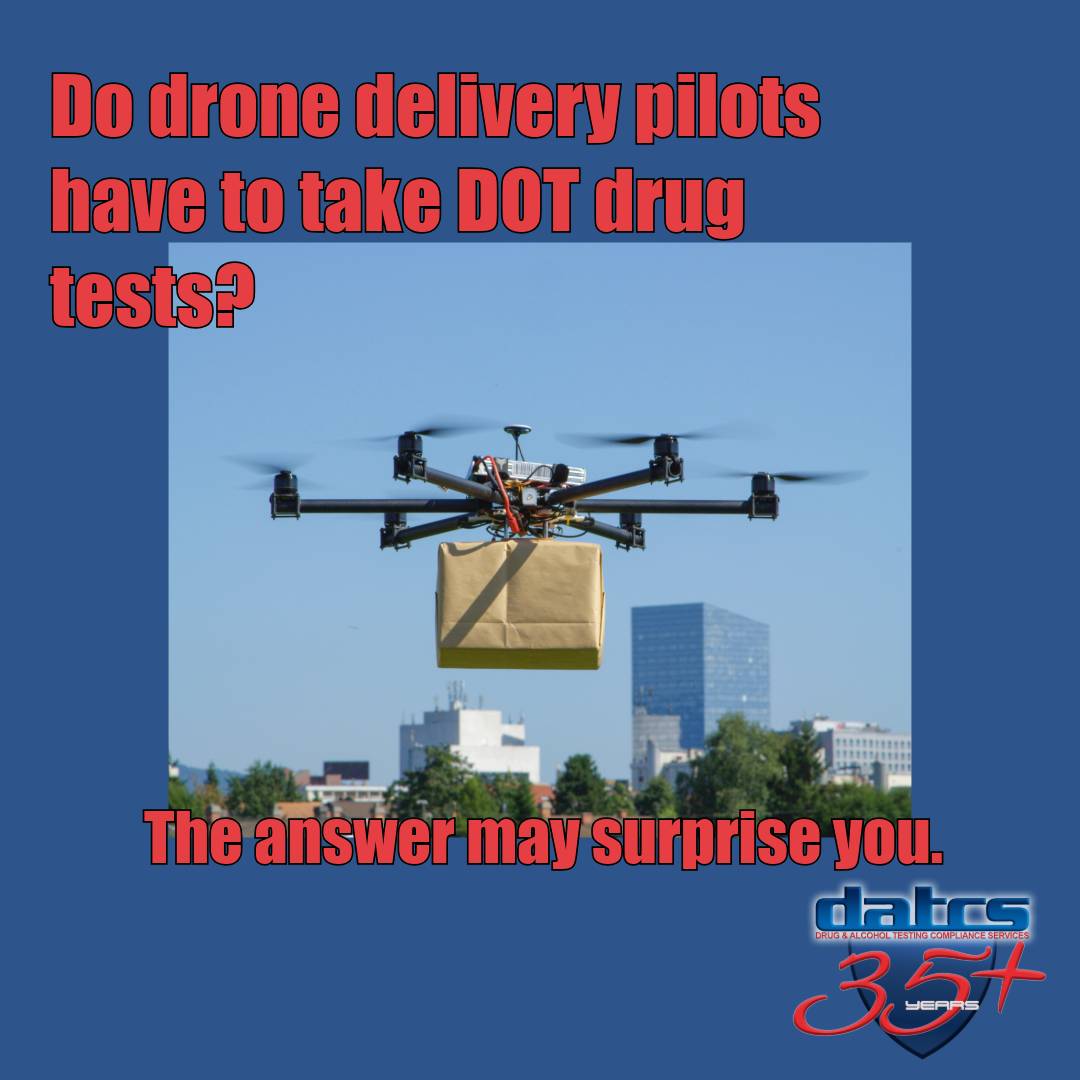
Do drone delivery pilots have to be drug tested under DOT or FAA rules?
The answer is: not automatically.
The FAA has not created a standalone drug-testing regulation specifically for drone delivery pilots. Instead, certain FAA-regulated drone delivery operations — especially operations conducted by a Part 119 certificate holder with Part 135 authority — may be subject to the FAA’s existing Drug and Alcohol Testing Program under 14 CFR Part 120. Whether testing applies depends on both the employer’s operating authority and whether the individual performs a covered safety-sensitive function.
That distinction matters. A remote pilot operating only under Part 107 is not automatically covered by FAA Part 120 drug and alcohol testing requirements. Part 107 may allow limited transportation of property for compensation or hire when all Part 107 requirements are met, including visual line-of-sight requirements, weight limits, secure external loads, and other operating restrictions.
Employers must also be careful not to use DOT drug testing as a general workforce testing tool. FAA guidance states that no one is permitted to conduct a DOT drug or alcohol test on an individual who is not a DOT-regulated employee. If a company wants to test non-covered workers, that testing should be handled under a separate non-DOT company policy, subject to applicable laws.
For drone delivery companies, the key compliance question is not simply, “Do we operate drones?” The better question is:
What authority are we operating under, and which employees or contractors are performing covered safety-sensitive functions?
New to Drone Delivery? Key Industry Terms and Acronyms
The drone delivery industry uses a mix of aviation, transportation, and workplace compliance terminology. If your organization is new to FAA or DOT-regulated operations, the following terms will help clarify the discussion.
You may want to publish this section as a collapsible glossary after the introduction.
Click to expand: Drone delivery industry terms and acronyms
FAA — Federal Aviation Administration
The federal agency responsible for regulating civil aviation in the United States, including unmanned aircraft operations.
DOT — U.S. Department of Transportation
The federal department responsible for transportation safety programs, including drug and alcohol testing procedures for safety-sensitive transportation employees.
UAS — Unmanned Aircraft System
The FAA’s term for a drone and the related equipment needed to operate it, including the aircraft, control station, communication links, and supporting systems.
Remote Pilot
An individual who operates or supervises operation of a drone from a ground-based location rather than from inside the aircraft.
Part 107
The FAA regulation governing many small commercial drone operations in the United States. Part 107 applies to small UAS operations and includes operating rules such as visual line-of-sight requirements, aircraft weight limitations, and restrictions on certain types of operations.
Part 119
The FAA regulation that addresses certification requirements for certain air carriers and commercial operators.
Part 135
The FAA regulation governing certain commuter and on-demand air carrier operations. The FAA’s package delivery by drone materials describe commercial drone package delivery operations under 14 CFR Part 135.
Part 120
The FAA regulation governing certain commuter and on-demand air carrier operations. The FAA’s package delivery by drone materials describe commercial drone package delivery operations under 14 CFR Part 135.
BVLOS — Beyond Visual Line of Sight
Drone operations where the aircraft flies beyond the remote pilot’s direct visual observation.
VLOS — Visual Line of Sight
Drone operations where the aircraft remains visible to the remote pilot or visual observer during flight.
Safety-Sensitive Function
A regulated duty that directly impacts aviation safety. FAA guidance lists safety-sensitive functions including flight crewmember, flight attendant, flight instruction, aircraft dispatcher, aircraft maintenance and preventive maintenance, ground security coordinator, aviation screening, air traffic control, and operations control specialist duties.
Covered Employee
An individual who performs a covered safety-sensitive function and may therefore be subject to DOT/FAA drug and alcohol testing requirements.
Covered Function
A regulated safety-sensitive duty. Coverage depends on actual duties performed, not merely job title.
MRO — Medical Review Officer
A licensed physician responsible for reviewing laboratory drug-test results, evaluating whether there is a legitimate medical explanation for certain results, and reporting verified results according to DOT procedures.
DER — Designated Employer Representative
The employer representative responsible for managing key parts of a DOT-regulated drug and alcohol testing program, including receiving results and coordinating required employer actions.
C/TPA — Consortium/Third-Party Administrator
A service agent that may assist employers with drug and alcohol testing program administration, random selections, training materials, and compliance support. Employers remain responsible for compliance even when using service agents.
SAP — Substance Abuse Professional
A qualified professional involved in the DOT return-to-duty process after an employee violates DOT drug or alcohol testing rules.
A449 Operations Specification
An FAA operations specification related to the Drug and Alcohol Testing Program for covered Part 119 certificate holders operating under Part 121 or Part 135 authority.
Non-DOT Testing
Drug or alcohol testing conducted under an employer’s own workplace policy rather than DOT regulations. Non-DOT testing must remain separate from DOT-regulated testing programs.
Quick Applicability Checklist: Does Part 120 Apply to Your Drone Operation?
Before implementing a DOT/FAA drug and alcohol testing program, drone delivery employers should ask:
- Are we operating only under Part 107?
- Are we operating under, or seeking, Part 119 and Part 135 authority?
- Are employees or contractors performing listed Part 120 safety-sensitive functions?
- Are we evaluating actual job duties rather than job titles?
- Have we separated DOT-regulated testing from any non-DOT company testing?
- Do we have a DER, MRO process, SAP process, written policy, random pool, and recordkeeping procedure?
- Are contractors performing covered work enrolled in or covered by an appropriate FAA-mandated testing program?
- Have we reviewed the active FAA guidance, including AC 120-126A?
This checklist is not a substitute for legal or regulatory guidance, but it gives employers a practical starting point. The researcher’s review specifically recommended adding this type of self-assessment because the original article explained the rules but did not give employers a clear way to evaluate whether the rules may apply to their operation.
Part 107 vs. Part 135: The Distinction Employers Must Understand
Many employers assume that if they operate drones commercially, they must automatically follow FAA drug and alcohol testing rules.
That is not correct.
Part 107-Only Operations
Part 107 governs many commercial small UAS operations. FAA guidance states that Part 107 permits transportation of property for compensation or hire if the operator complies with all provisions of the rule. These include keeping the UAS within visual line of sight, not conducting the flight from a moving vehicle when transporting another person’s property for compensation or hire, securely attaching external loads, keeping the aircraft with payload under 55 pounds at takeoff, and keeping the transportation within applicable geographic limitations.
A remote pilot operating only under Part 107 is not automatically subject to FAA Part 120 drug and alcohol testing. That does not mean the employer has no safety obligations, and it does not prevent an employer from having a lawful non-DOT workplace policy. But it does mean the employer should not automatically place Part 107-only personnel into a DOT testing program unless they are truly DOT-regulated employees performing covered functions.
Part 135 Drone Delivery Operations
Part 135 is different. The FAA’s package delivery by drone page describes commercial drone package delivery operations conducted under 14 CFR Part 135 and explains that the FAA’s role includes safety in the National Airspace System, operator certification under FAA Part 135, and compliance with environmental review requirements.
Recent industry reporting also shows continued movement toward Part 135 operating models in drone delivery. For example, July 2026 reporting described Matternet expanding its drone delivery operator network through a new FAA Part 135 operating partner, Beeline UAS, supporting BVLOS operations in California markets.
The key point for employers is this:
Package delivery does not automatically equal Part 135, and drone operations do not automatically equal DOT drug testing.
Instead, employers must evaluate their operating authority and the actual duties performed by employees and contractors.
Why FAA-Certificated Drone Delivery Operations Can Trigger Existing Testing Rules
The FAA’s Part 120 rule applies to certain aviation employers and employees. Part 120 applies to air carriers and operators certificated under Part 119 and authorized to conduct operations under Part 121 or Part 135, individuals who perform safety-sensitive functions directly or by contract, certain Part 145 certificate holders, and certain contractors.
The purpose of Part 120 is to help prevent accidents and injuries resulting from prohibited drug use or alcohol misuse by employees performing aviation safety-sensitive functions. Part 120 also requires covered employers to ensure that drug and alcohol testing conducted under the rule complies with DOT procedures in 49 CFR Part 40.
FAA Advisory Circular 120-126A, issued April 8, 2025, provides guidance for establishing, implementing, and maintaining a DOT/FAA drug and alcohol testing program under 14 CFR Part 120 and 49 CFR Part 40. Importantly, the AC states that it does not create new regulatory requirements and does not authorize deviations from existing requirements.
That is why this topic should be framed carefully. This is not a brand-new “drone pilot drug testing rule.” It is the application of existing FAA/DOT testing rules to covered aviation operations when the regulatory conditions are met.
DOT Testing Is Not a General Workforce Testing Tool
This is one of the most important compliance points for drone delivery employers.
A company should not take the position that because some employees may be covered by FAA Part 120, all drone-related personnel can be placed into a DOT random pool.
FAA guidance states that no one is permitted to conduct a DOT drug or alcohol test on an individual who is not a DOT-regulated employee.
That means employers must distinguish between:
|
Worker Category |
DOT/FAA Testing? |
|
Employee performing a covered safety-sensitive function |
Potentially yes |
|
Contractor performing a covered safety-sensitive function |
Potentially yes |
|
Part 107-only remote pilot with no Part 120-covered function |
Not automatically |
|
Administrative employee |
No, unless independently covered |
|
General operations support staff |
No, unless performing a covered function |
|
Non-covered employee under company policy |
Use separate non-DOT policy, not DOT testing |
If an employer wants to test non-covered personnel, that testing may be addressed through a separate company policy, subject to applicable federal, state, and local law. DOT and non-DOT testing programs should remain separate.
Which Drone Delivery Employees May Be Covered?
Coverage depends on duties, not titles.
FAA guidance on AC 120-126A identifies safety-sensitive functions including:
- Flight crewmember duties
- Flight attendant duties
- Flight instruction duties
- Aircraft dispatcher duties
- Aircraft maintenance and preventive maintenance duties
- Ground security coordinator duties
- Aviation screening duties
- Air traffic control duties
- Operations control specialist duties
Drone delivery roles do not always map neatly onto traditional aviation job titles. That is why employers should examine what employees and contractors actually do. A person’s title may say “remote pilot,” “operations specialist,” “flight operations coordinator,” or “UAS technician,” but the compliance question is whether that person performs a listed safety-sensitive function under the applicable FAA framework.
Contractors also require careful review. Part 120 applies to individuals performing safety-sensitive functions directly or by contract, and employers should verify whether contract employees performing covered functions are included in an appropriate FAA-mandated testing program before covered work begins.
What Types of Drug and Alcohol Testing May Be Required?
When FAA Part 120 applies, covered employers must follow DOT testing procedures in 49 CFR Part 40.
Common DOT/FAA testing categories include:
Pre-Employment Drug Testing
Covered employees generally must have a verified negative drug test before performing safety-sensitive functions.
Random Drug and Alcohol Testing
Covered employees may be placed into a scientifically valid random testing pool. Employers should be careful to include only DOT-regulated covered employees in the DOT pool.
Reasonable Cause or Reasonable Suspicion Testing
Testing may be required when trained supervisors observe signs or evidence that meet regulatory standards for testing. Supervisor training is an important part of a defensible compliance program.
Post-Accident Testing
Certain aviation events may trigger post-accident testing obligations under FAA/DOT rules.
Return-to-Duty and Follow-Up Testing
Employees who violate DOT drug and alcohol testing rules must complete the required return-to-duty process before resuming covered safety-sensitive duties.
Pre-Employment Alcohol Testing
Pre-employment drug testing is generally required before a covered employee performs safety-sensitive functions. Pre-employment alcohol testing is permitted under certain circumstances but is not generally required, according to the researcher’s regulatory review.
Marijuana: A Critical Compliance Issue for Safety-Sensitive Employees
Marijuana remains one of the most misunderstood issues in DOT-regulated testing.
DOT’s marijuana notice states that marijuana remains unacceptable for safety-sensitive employees subject to DOT drug testing, and DOT’s testing process and regulations continue to apply to marijuana testing.
DOT’s May 2026 Part 40 Q&A further states that an MRO cannot verify a laboratory-confirmed marijuana positive drug test as negative simply because the employee claims the positive resulted from a state-licensed marijuana product. The Q&A also states that state-issued medical marijuana cards, physician recommendations, certifications, dispensary records, and receipts do not satisfy Part 40 requirements for a legitimate medical explanation.
For FAA/DOT-covered drone delivery employees, the practical message is clear:
State marijuana legalization does not override DOT drug testing requirements for covered safety-sensitive workers.
What This Means for Drone Delivery Employers
For companies entering FAA-regulated drone delivery operations, compliance can feel overwhelming. The employer may understand drone technology, logistics, routing, and customer service, but FAA/DOT drug and alcohol testing adds a different layer of responsibility.
DATCS can help employers evaluate whether FAA/DOT testing requirements may apply, identify covered safety-sensitive roles, separate DOT and non-DOT testing needs, establish random testing and DER processes, coordinate MRO services, support policy development, assist with post-accident and reasonable suspicion processes, and prepare for compliant program administration. The researcher’s review noted that DATCS materials position the company around DOT compliance, audit assistance, MRO service, customized policy development, computerized random selections, training, and 24/7 post-accident and reasonable-suspicion support. [Review of…ng Article | Word]
For drone delivery operators, DATCS may be able to assist with:
- DOT/FAA drug and alcohol testing program setup
- DOT drug testing administration
- Random consortium or random pool management
- DER support
- MRO coordination
- Supervisor training
- Reasonable suspicion training
- Post-accident testing support
- Drug and alcohol policy development
- DOT vs. non-DOT testing separation
- Contractor compliance documentation review
- Recordkeeping and audit preparation
- Ongoing compliance consultation
Not sure whether FAA Part 120 applies to your drone delivery operation? DATCS can help review your operating authority, identify covered safety-sensitive roles, separate DOT and non-DOT testing needs, and build a compliant testing program before launch.
Frequently Asked Questions About FAA Drug Testing for Drone Delivery Operators
Do drone delivery pilots have to take DOT or FAA drug tests?
Not automatically. A remote pilot operating only under Part 107 is not automatically subject to FAA Part 120 drug and alcohol testing. Testing may apply when the employer is a covered FAA-regulated employer, such as a Part 119 certificate holder authorized for Part 135 operations, and the individual performs a listed safety-sensitive function.
Does Part 107 require DOT drug testing for drone pilots?
No. Part 107 alone does not automatically require DOT drug or alcohol testing. Part 107 may allow limited transportation of property for compensation or hire when all Part 107 requirements are met, but Part 120 testing depends on the operator’s certification status and the employee’s actual duties.
Are all drone pilots safety-sensitive employees?
No. Coverage depends on whether the employer is subject to Part 120 and whether the individual performs a listed safety-sensitive function. Employers should evaluate actual duties rather than job titles.
Can non-covered drone employees be included in a DOT random pool?
No. FAA guidance states that DOT drug or alcohol tests may not be conducted on individuals who are not DOT-regulated employees. Non-covered workers should be handled under a separate non-DOT company policy if the employer chooses to test them.
Are contractors covered by FAA drug testing rules?
They may be. Part 120 applies to individuals who perform safety-sensitive functions directly or by contract. Employers should verify contractor coverage and compliance before contractors perform covered safety-sensitive work.
What is FAA Part 120?
FAA Part 120 is the FAA’s Drug and Alcohol Testing Program regulation. Its purpose is to help prevent accidents and injuries resulting from prohibited drug use or alcohol misuse by employees performing aviation safety-sensitive functions.
What is AC 120-126A?
AC 120-126A is an FAA advisory circular issued April 8, 2025. It provides guidance for establishing, implementing, and maintaining a DOT/FAA drug and alcohol testing program under 14 CFR Part 120 and 49 CFR Part 40. It also cancels the prior AC 120-126.
Is pre-employment alcohol testing required?
Pre-employment drug testing is generally required before a covered employee performs safety-sensitive functions. Pre-employment alcohol testing is permitted under certain circumstances but is not generally required, according to the researcher’s review.
What drugs are included in DOT testing?
DOT laboratories test for marijuana metabolites, cocaine metabolites, amphetamines, opioids, and PCP. DOT laboratories must not test DOT specimens for other drugs.
Does medical marijuana count as a legitimate medical explanation for a DOT marijuana positive?
No. DOT’s May 2026 Part 40 Q&A states that an MRO cannot verify a laboratory-confirmed marijuana positive as negative based on the employee’s claim that the positive resulted from a state-licensed marijuana product.
How can DATCS help drone delivery companies?
DATCS can help employers evaluate FAA/DOT testing applicability, identify covered safety-sensitive functions, separate DOT and non-DOT programs, establish random testing processes, coordinate MRO services, support DER responsibilities, assist with policy development, and provide compliance support.
Conclusion: Drone Delivery Is New, But the Safety Principle Is Not
Drone delivery is becoming a meaningful part of the U.S. transportation and logistics landscape. But as operators move from basic commercial drone activity into more advanced delivery models, they may encounter FAA and DOT compliance obligations that are unfamiliar.
The most important takeaway is this:
Drone delivery does not automatically require DOT drug testing, but certain FAA-certificated drone delivery operations may trigger Part 120 requirements when employees or contractors perform covered safety-sensitive functions.
Employers should avoid assumptions in either direction. They should not ignore Part 120 if they are operating under a covered FAA structure, but they also should not place non-covered employees into a DOT testing program simply because those employees work around drones.
The safest path is a careful compliance review focused on operating authority, actual duties, contractor roles, DOT vs. non-DOT testing separation, and current FAA guidance.
For drone delivery companies preparing to launch, expand, or move into Part 135 operations, DATCS can help build the compliance foundation needed to support safe, responsible, and legally defensible operations.
Sources for Review and Citation
- FAA AC 120-126A, Guidelines to Establish, Implement, and Maintain a DOT/FAA Drug and Alcohol Testing Program [faa.gov], [faa.gov]
- 14 CFR Part 120, Drug and Alcohol Testing Program [ecfr.gov]
- FAA Part 107 package delivery FAQ [faa.gov]
- FAA Part 107 overview [faa.gov]
- FAA Package Delivery by Drone, Part 135 [faa.gov]
- Federal Register notice on drone package delivery operations under Part 135 [federalregister.gov]
- DOT 49 CFR § 40.82 drug testing panel [ecfr.gov], [transportation.gov]
- DOT May 2026 Part 40 marijuana Q&A [transportation.gov]
- DOT marijuana notice [transportation.gov]
- Researcher review of DATCS drone pilot drug testing article [Review of…ng Article | Word]
- Recent industry reporting on Part 135 drone delivery expansion [dronelife.com], [tmcnet.com]