
Background Check

Ensure compliant, reliable, and FCRA-aligned pre-employment screening for drivers, safety professionals, and regulated personnel nationwide.
At DATCS, we provide comprehensive background check services designed to support compliance-driven employers across regulated industries. Our screening solutions help verify driver qualifications, employment history, criminal records, and work eligibility while aligning with FCRA requirements and industry regulations. With accurate reporting, clear documentation, and nationwide coverage, we help organizations make confident hiring decisions while reducing risk and maintaining regulatory compliance.
Why Background Checks Matter for Your Business
Hiring in regulated and safety-sensitive environments leaves little room for error. A single overlooked record, unverified credential, or compliance misstep can expose your business to liability, fines, operational disruptions, and reputational damage. Comprehensive background checks help ensure that every individual you bring into your organization meets regulatory requirements, safety standards, and internal policies before they step into the role.
At DATCS, we designed our background screening services to protect your business at every stage of the hiring process. By validating driving history, criminal records, employment and education credentials, and work eligibility, we help you reduce risk, improve workforce quality, and make confident, defensible hiring decisions, without slowing down operations or compromising compliance.

Why Choose DATCS for Background Checks
Proud PBSA Member
Committed to ethical background screening, accuracy, and industry best practices.
Proven Industry Experience
In business since 1989. We support DOT, transportation, and safety-sensitive employers with industry-specific background screening expertise.
End-to-End Screening Services
One provider for FMCSA, criminal, employment, education, and work eligibility background checks.
Nationwide Coverage
We provide background screening services nationwide, regardless of your company or candidate location.
Court-Level Criminal Searches
County and federal court searches deliver reliable, up-to-date criminal record information.
Clear, Actionable Reporting
Simple, well-documented reports support informed, defensible hiring decisions.
Flexible Screening Packages
Background check services customized to job roles, hiring volume, and regulatory obligations.
Dedicated Compliance Support Team
Experienced compliance specialists guide employers through screening and regulatory questions.
Trusted by Employers Nationwide
Thousands of companies across many sectors rely on DATCS for compliant, reliable background screening services.
Explore Our Background Check Services
Reliable background screening is essential for organizations hiring in regulated and safety-sensitive environments. These services help employers verify qualifications, driving history, criminal records, employment and education credentials, and work eligibility, supporting FCRA alignment and regulatory compliance throughout the hiring process. Designed for consistency and scale, nationwide background check services deliver accurate reporting, clear documentation, and dependable turnaround times. By reducing hiring risk and supporting defensible employment decisions, employers can move forward with confidence while maintaining compliance and operational efficiency.
DOT & Transportation Compliance Checks
Compliance-focused screening for safety-sensitive driving roles

FMCSA Background Checks
FMCSA (Federal Motor Carrier Safety Administration) screening supports DOT-regulated hiring by verifying required driver information and safety history. This package includes an MVR for a specific state (additional state access fees may apply), a CDLIS check to confirm CDL status and identify additional states for driving record requests, and FMCSA employment verification of previous employer(s) to confirm DOT accident history (3 years required).
Delivers visibility into:
- State driving record (MVR)
- CDL status and additional licensing states
- DOT medical certification indicators
- Prior DOT accident history (3-year verification)
PHMSA Background Checks
PHMSA (Pipeline and Hazardous Materials Safety Administration) employment verification confirms whether a driver has had any past positive drug and/or breath alcohol tests with previous employer(s). This verification supports compliance-driven hiring for safety-sensitive roles (2 years required).
Delivers visibility into:
- Prior positive drug test history
- Prior positive breath alcohol test history
- Compliance verification for safety-sensitive roles
- Required PHMSA employment history timeline
PSP (Pre-Employment Screening Program)
The PSP (Pre-Employment Screening Program) provides secure electronic access to a commercial driver’s five-year crash history and three-year inspection history through FMCSA’s Motor Carrier Management Information System (MCMIS). This program supports carriers in making informed driver hiring decisions using federal safety performance records.
Delivers visibility into:
- Five-year crash history
- Three-year roadside inspection history
- Safety performance patterns from MCMIS
- Carrier-focused pre-employment screening data
CDLIS (Commercial Driver’s License Information System)
CDLIS (Commercial Driver’s License Information System) is a database search used to verify that an applicant holds a valid commercial driver’s license (CDL). It may also identify states where an applicant lived or worked beyond what was reported on an employment application and can be used as a pre-pull tool for criminal searches.
Delivers visibility into:
- Verified commercial driver license status
- Potential multi-state licensing activity
- Unreported states of residence or employment
- Expanded jurisdiction indicators for screening
MVR / Driving Record Checks
The MVR (Motor Vehicle Report) contains state driving record information dating back at least three years and is obtained directly from the specified state’s Department of Motor Vehicles (additional state access fees may apply). This screening supports employers with driving responsibilities by providing confidence in license history and can also support identity verification through date of birth and middle name confirmation.
Delivers visibility into:
- Driving history (3+ years)
- License status and violations
- Identity verification indicators (DOB, middle name)
- Risk factors for driving-required positions
Criminal Background Screening
Court-level criminal record searches nationwide

Federal District Court Criminal Records Checks
A nationwide criminal check is a check of our proprietary database and is a search of multiple criminal record sources, including Social Security Trace, FBI most wanted and Interpool Fugitives list, state, and county criminal record repositories, prison parole and release files, Sex Offender Registry, and records from other state agencies. This exclusive criminal search includes access to millions of criminal conviction records across the United States. Results are typically available within seconds when ordered via our secure Internet website and all information is FCRA compliant. This search cannot be used to make a hiring decision unless a County Criminal Search is processed when there is negative information on a report.
Delivers visibility into:
- Nationwide criminal conviction indicators
- Multi-source criminal record repositories
- Watchlist-related records (FBI / Interpol)
- Records requiring county confirmation for hiring
County Criminal Investigation (7-Year Search)
This search is commonly considered the GOLD STANDARD criminal search and is an FCRA-compliant product. It searches each jurisdiction where the applicant has lived, worked, or attended school in the past seven years. DATCS uses a network of 3,000+ independent court researchers to complete hand searches of county court records, locating records of conviction and arrests as allowed by state law. County records may include state felonies, state misdemeanors, federal felonies, and federal misdemeanors.
Delivers visibility into:
- County-level criminal records (hand searched)
- Jurisdiction-based coverage for 7 years
- Felony and misdemeanor case history
- Court-level accuracy across counties
Statewide Criminal Database Search
This flexible statewide database search provides near-instant access to criminal records from each of the 50 state court criminal record systems. The search may include criminal, civil, traffic, and domestic cases, and can be configured to search a single county or all counties statewide. Because statewide searches rely on database results, any “hit” must be confirmed through a county-level hand search to be FCRA compliant for hiring decisions.
Delivers visibility into:
- Statewide criminal record indicators
- Multi-county court system data
- Civil, traffic, and domestic cases (where included)
- Database hits requiring county confirmation
Employment & Education Verification
Credential and work history confirmation

Education Verification
Education verification provides direct confirmation of an applicant’s highest level of educational achievement, including dates of attendance, year of graduation, major course of study, degree or diploma earned, GPA (when available), and any special achievements or awards. Information is obtained directly from the educational institution or through an authorized third-party provider. Because education details are commonly misrepresented on employment applications, this verification supports accurate, defensible hiring decisions. Unless otherwise specified, only the highest degree achieved is confirmed.
Delivers visibility into:
- Highest degree or diploma confirmed
- Attendance and graduation details
- Major course of study
- GPA and honors (when available)
Employment History Verification & References (Price Per Previous Employer)
Employment verification is a manual check of applicant-reported employment history that typically requires contacting a supervisor, Human Resources department, or valid third-party provider. Information may include employer name, dates employed, job title(s), job performance, reason for leaving, eligibility for rehire, and other job-related details as available. DATCS also provides a Date Scan function that arranges verified employment dates chronologically, helping identify employment gaps of 30 days or more, and partial or full overlap periods.
Delivers visibility into:
- Verified employer name and employment dates
- Job titles and role consistency
- Rehire eligibility and reason for leaving (when available)
- Employment gaps and overlap patterns (Date Scan)
Work Authorization & Compliance Services
Employment eligibility and documentation support

I-9 Electronic Document Management
Federal law requires employers to retain I-9 forms for all employees, including U.S. citizens. DATCS provides electronic I-9 records and complete I-9 management support, helping employers securely store and verify electronic I-9 forms. Form I-9 must be retained for three years after the date of hire or one year after employment ends, whichever is later, reducing administrative burden and improving audit readiness.
Delivers visibility into:
- Electronic I-9 storage and verification
- Record retention compliance timelines
- Centralized documentation readiness
- Reduced paper handling and risk
E-Verify INS / SSA / DHS Identity Check
In addition to traditional credit header tools, DATCS offers INS verification that verifies an individual’s Social Security number and right to work in the United States. DATCS integrates directly with the Department of Homeland Security (DHS) database and the Social Security Administration (SSA), enabling streamlined post-hire I-9 verification. This search can also verify citizenship.
Delivers visibility into:
- SSN verification and identity validation
- Right-to-work confirmation
- DHS and SSA database verification results
- Post-hire I-9 verification support
Pre-Adverse Action Letter
Section 604 of the FCRA requires employers to provide the employee a copy of the background report and a summary of their rights under the FCRA before taking adverse action based on a report. If a background report may impact a hiring decision, the employer must send the Pre-Adverse Action letter before making a final decision, helping support compliance and defensible hiring practices.
Delivers visibility into:
- Required FCRA pre-adverse action steps
- Candidate notification documentation
- Report disclosure and rights summary requirements
- Compliance support before final hiring action
Choosing the Right Background Check for the Right Role
We provide nationwide background check solutions for employers of all sizes. Whether you’re hiring for safety-sensitive roles, on-site teams, or office positions, our screening services help reduce risk, support compliance, and strengthen hiring decisions.
Background check services are commonly used for roles such as:
- Drivers & Safety-Sensitive Positions: Support FMCSA screening, MVR checks, and DOT-aligned hiring.
- Skilled Field & On-Site Teams: Verify identity, work history, and job-site eligibility.
- Management & Administrative Hiring: Confirm employment, education, and criminal history when needed.
- Remote & Multi-State Hiring: Run consistent screening regardless of candidate location.
- High-Trust Positions: Add deeper verification for sensitive responsibilities.
And more. Screening packages can be tailored to your needs.
Ready to get started? Contact a specialist today to build the right screening package.
Background Check - Common Terms
Understanding background check terminology can make the screening process much easier to navigate. From case outcomes to legal reporting requirements, these common terms help explain what may appear on a criminal background check and how those records are typically interpreted during the screening process.
The final outcome of a case, including sentencing and other relevant details.
Indicates an individual has been found guilty of a crime. Depending on state law, not all
conviction records may be used in hiring decisions.
All charges are dropped and the case is closed. In some jurisdictions, dismissed records may
still be considered during hiring.
A record that has been legally removed or sealed as if the arrest never occurred. Expunged or sealed records cannot be used in hiring decisions.
A plea arrangement in which charges are dismissed after the defendant completes courtordered requirements such as probation, treatment, or community service.
The Fair Credit Reporting Act, a federal law governing how consumer information—including background check data—is collected, verified, and reported. All employers and Consumer Reporting Agencies (CRAs) must comply with FCRA requirements.
Background Check - Common Questions
Hiring and compliance requirements can vary by role, location, and industry. Below are answers to the most common background check questions employers ask, including criminal lookback periods, DOT/FMCSA screening, FCRA pre-adverse action requirements, I-9 compliance, and verification services. Use this guide to support confident, defensible hiring decisions.
Most employment background checks focus on a 7-year lookback, especially for county criminal searches and address history-based screening. In some cases, a 10-year lookback may be requested depending on company policy, job sensitivity, or state law. The exact timeframe can vary based on the type of search, the jurisdiction, and applicable reporting rules.
FCRA pre-adverse action requires employers to provide the candidate with a copy of the consumer report (background check) and a Summary of Rights under the FCRA before making a final adverse hiring decision. This process gives the individual an opportunity to review the information and dispute inaccuracies. Employers should allow a reasonable waiting period before sending a final adverse action notice.
DOT/FMCSA compliant background checks typically include verifying a driver’s Motor Vehicle Record (MVR), confirming previous employment and safety performance history, and completing all required documentation for the driver qualification file. Employers may also review PSP history and conduct additional screening based on role requirements. Compliance steps must follow FMCSA hiring standards and be documented accurately.
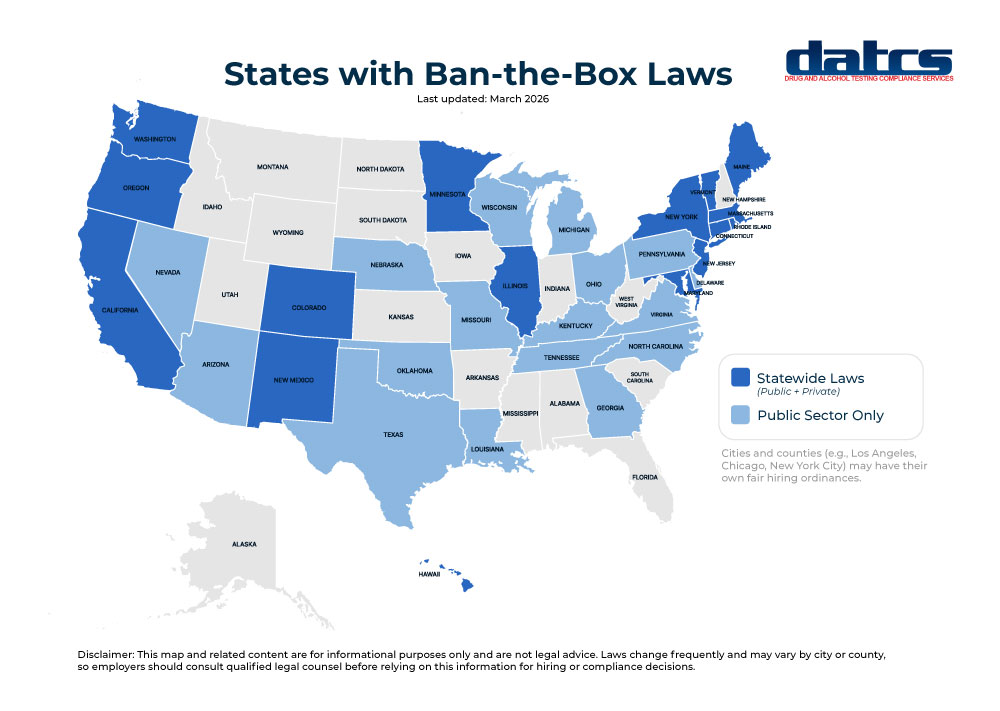
“Ban-the-Box” refers to fair hiring laws that restrict when employers can ask about a candidate’s criminal history during the hiring process. In most cases, these laws remove the criminal history checkbox from initial job applications, allowing candidates to be evaluated first based on their skills, experience, and qualifications before a background check is conducted.
Ban-the-box laws exist across many U.S. states, but the scope varies. Some states apply these regulations only to public sector employers, while others extend them to private employers and require additional steps such as individualized assessments before making hiring decisions.
Because these laws differ by state, city, and employer type—and are frequently updated—employers must review the latest requirements based on the job location to remain compliant and reduce hiring risk.
In some cases, yes. Whether employers can consider criminal records older than seven years depends on the type of record, the reporting rules that apply, and state-specific restrictions. Many employers use a 7-year standard for consistency, but certain convictions may remain reportable longer depending on jurisdiction and job requirements.
A county criminal search checks local courthouse records where most misdemeanors and felonies are filed. A statewide search reviews available state-level repositories and may be used as a supplement. A federal criminal search checks U.S. District Court records for crimes prosecuted at the federal level. Employers often combine these searches to improve coverage and accuracy.
In 2026, employers must ensure Form I-9 is completed correctly for every hire, including verifying identity and work authorization documents within required timeframes. Employers must also follow I-9 retention rules, keeping forms for three years after hire or one year after employment ends, whichever is later. Maintaining organized, audit-ready I-9 records remains a critical compliance requirement.
Continuous background monitoring helps employers stay informed after hiring by screening for relevant updates such as changes in driving status or new reportable records, depending on the monitoring program used. Instead of running checks only once at onboarding, employers can implement ongoing monitoring to support risk management and policy compliance. Monitoring should follow applicable laws and company guidelines.
Education verification checks confirm an applicant’s highest level of achievement, including school attended, dates of attendance, year of graduation, major course of study, and degree or diploma earned. Depending on availability, verification may also include GPA and academic honors or awards. Education verification helps reduce risk from credential misrepresentation during hiring.
Background checks draw from multiple information sources—county and federal courts, state
repositories, databases, credit bureaus, schools, employers, and more. Each source has its own
timelines, processes, and potential delays. The overall turnaround time depends on the scope
and complexity of the screening.
Common Reasons for Delays:
1. Unresponsive institutions or individuals
Slow responses from schools, employers, or candidates can delay verification steps.
2. Court delays
Staffing shortages, limited resources, natural disasters, or nondigitized records can slow
down searches. Manual record retrieval may take 3–30 days, depending on the county.
3. Multiple data sources
More comprehensive screenings require more searches, increasing processing time.
4. Aliases or name changes
Additional names require expanded research and crossverification.
5. International checks
Differences in documentation, language, and government systems can extend timelines.
6. Incorrect or incomplete information
Errors in applications or personal identifiers frequently slow the process.
While external data sources can’t be rushed, candidates can take steps to help avoid
unnecessary delays. DATCS recommends the following:
1. Keep Information Ready
Have details such as aliases, prior addresses, employment dates, and education history
prepared before completing forms.
2. Provide Accurate Information
Incorrect personal, employment, or education details often add days to the process. Accurate
information allows researchers to start verification immediately.
3. Support Quality Assurance Processes
Screening providers must comply with the FCRA, which requires verifying any conflicting or adverse information. Although this step may add time, it prevents future disputes and
ensures accuracy.
4. Respond Quickly to Requests
If a former employer or school is unresponsive, candidates may be asked to provide
alternative documents (e.g., W2s, pay stubs, diplomas). Prompt responses help avoid delays.
DATCS Background Screening Timing
Most background checks are completed within one to two business days, with realtime
updates provided for any delays. While instant results aren’t realistic, experienced screening
specialists often reduce a multiday process to as little as one business day.
Ready to Hire? Get Background Checks Completed Today
DATCS is here to help you move hiring forward with compliant, reliable screening and clear reporting. Contact us today to speak with a specialist and get started.
Need to Find a Location Near You?
Learn More About Background Checks
Call 903-247-9546 for Emergency Assistance 24/7
Need mobile or on-site drug and alcohol testing? DATCS dispatches certified collectors anytime, anywhere—day or night. Whether it’s a DOT post-accident test or urgent workplace screening, we’re ready when you need us.